







Four times a year, companies release something that turns investors into either ecstatic people or miserably sleep-deprived: earnings reports.
Q1 earnings: Released in April and May
Q2 earnings: Released in July and August
Q3 earnings: Released in October and November
Q4 earnings: Released in January and February
Earnings are simply a company’s profit; the money left after paying for salaries, supplies, electricity, and everything else required to keep the lights on. Investors care about this number because it tells them if a company is succeeding or slowly melting like an ice cube in a microwave.
In hindsight, earnings are basically financial report cards. Wall Street analysts guess the company’s grades beforehand, and if the real numbers beat the guesses, the stock often goes up. Sometimes a company does great, but if investors expected AMAZING, and it didn’t reach their definition of “amazing”, the stock still falls. It’s like getting an A, but your parents were expecting an A+.
One major part of earnings is EPS: Earnings Per Share. It tells you how much profit the company gets from each share of stock. EPS is equal to the profit divided by the number of shares. The higher the EPS, the better the performance the stock has. If EPS beats expectations, investors smile. If it misses… well…
Royal Caribbean’s latest earnings quarter ended in September 2025, with its results published on October 28th. Here’s how it went:
Revenue: $5.14B
→ Up 5.2% from last year
→ Slightly below expectations ($5.17B) 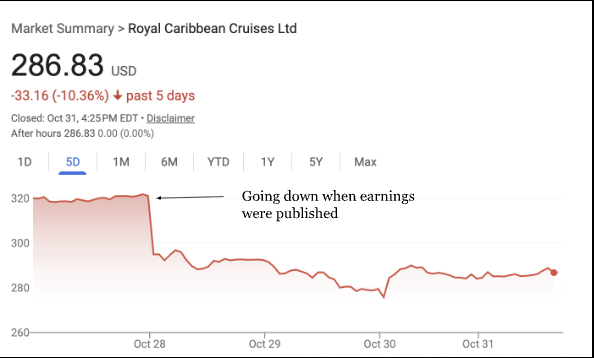
EPS: $5.75
→ Higher than last year’s $5.20
→ Beat expectations ($5.68)
Royal Caribbean did well, just not “Wall Street fairy-tale ending” well. The revenue was just a tiny bit lower than expected, and that’s enough to make investors nervous because apparently a $30 million difference on a $5 billion revenue is a full-blown crisis.. In simpler terms, A- report card, but Wall Street expected an A+, which is why the stock went down.
Some investors look at earnings predictions and make a bet that the stock will rise, or at least not fall too much. This general idea is called a bullish earnings play. A bullish earnings play can be done in different ways: Buying the stock, buying call options- the tool used to bet on a stock price increase, selling put options- the tool used to bet on a stock price decrease, or more variants.
Before earnings, I believed Royal Caribbean’s stock would stay above $295. Because of this, I bought call options. Unfortunately, revenue came in slightly below expectations, and the stock slipped. So, instead of taking the loss, I rolled the trade to November. In other words, I’m giving the stock extra time to behave itself.
To sum it up, earnings aren’t just about being “good.” They must be better than what everyone thought would happen or close to it. Earnings show whether companies are making money. The EPS tells us how much money the company makes per share. Royal Caribbean had a solid quarter, but slightly missed revenue expectations, which made the stock dip. Still, long-term believers (AKA me) simply rolled their trades forward, waiting for smoother seas.

Dr. A • Nov 13, 2025 at 2:31 pm
Very good explanation for why positive earnings don’t always mean positive capitalization! P.S.: I love “melting like an ice cube in a microwave.”